
Problem: Why Communities Stall
You followed the advice. Post consistently. Show up daily. Engage with your members.
And yet every time you step back, the community goes quiet. The community is doing exactly what the advice built it to do. The advice just left out the flywheel.
Your community stalls when you do because of the type of community you were taught to build. Same effort. Different structure. Different result.
The Advice Got You Here
You were told to show up consistently. Post daily. Engage your members personally. Respond to every comment. Be present.
And you did.
The advice is right. It is just incomplete. It tells you how to push the wheel. It never tells you how to build a flywheel.
Here is what most community builders are actually running: a community that needs them in the room.
Every day, they push. Members show up when they push. Engagement happens when they push. When they stop pushing, the wheel stops.
This is not a lazy person's community. This is what "show up consistently" actually builds: a presence-dependent engine.
The owner is the engine.
And engines run on fuel. Which means the moment the fuel runs out, such as a busy week, a holiday, a health setback, or a launch that went sideways, the community goes quiet.
This is not failure. This is design. The community was designed to need you.
The Contrast That Changes Everything
Our brains do not evaluate things in isolation. We compare. We contrast.
So when someone looks at their community and asks "why isn't this working?" their brain automatically compares the result to the effort. Forty hours a week. Inconsistent, unpredictable results. The math does not add up.
They assume they need to push harder. The answer is a different structure.
Old Way
- You are the engine.
- Community runs when you push it.
- More content fixes the problem.
- Chase engagement every day.
- Manually nudge members to participate.
- Community dies when you step back.
- Forty or more hours a week, with unpredictable results.
The Calm Engine Way
- You build the engine.
- Community runs because you built it right.
- One structured activation path fixes the problem.
- Activation creates engagement automatically.
- Members know exactly what to do when they join.
- The flywheel turns whether or not you are in the room.
- Under 60 minutes a week, consistently.
When You Know Where the Stall Is
You followed common advice. Common advice builds common results. That is what makes this so frustrating.
You did everything right. You stayed consistent. You showed up. And the community you built reflects exactly that. It runs when you push it, and it rests when you do.
The Calm Engine is about building differently, with the same effort redirected into structure instead of presence.
When you map your stall, the one place in your flywheel where momentum is leaking, you stop guessing and start engineering.
Content, visibility, and engagement are the symptoms.
Structure is the cause.
And structure problems have structure solutions.
The Calm Engine starts with the Momentum Map. It is one exercise, 10 minutes, that shows you exactly where your flywheel is stalling and what one lever, when pulled, gets it turning again.
Most people fill it in and say: "I knew something was off. I just did not know what to call it."
Now they do.
And when you know where the stall is, you stop pushing harder on the wrong thing. You build the thing that was missing. And the wheel starts turning on its own.
That is what The Calm Engine is for.
The Momentum Map is free. It is inside The Calm Engine classroom. It takes 10 minutes.
When you post it in the First Turns category, I respond personally with something specific to your community and exactly where your flywheel is stalling.
Every Flywheel Operator in this community started there. One map. One stall named. One lever to pull.
That is the First Turn.
Activation
Most community owners spend their energy getting members in the door.
Almost none of them have a plan for what happens the moment the door closes.
Your new member just joined. They clicked through the welcome post, maybe dropped a hello, and then went quiet. This is not a member problem. This is an activation problem. And it has a structure solution.
This is the same pattern behind why communities stall when the owner stops showing up.
Activation is not about being warm and welcoming. It is part of a bigger system most community builders are missing, what I call the community flywheel.
The Moment Most Owners Skip
There is a short window when a new member joins your community. Maybe 48 hours. In that window, they are curious, motivated, and genuinely open to being directed.
If that window closes without a clear first action, they drift. The next time they open the community, it feels like walking into a conversation that started without them.
What Activation Means
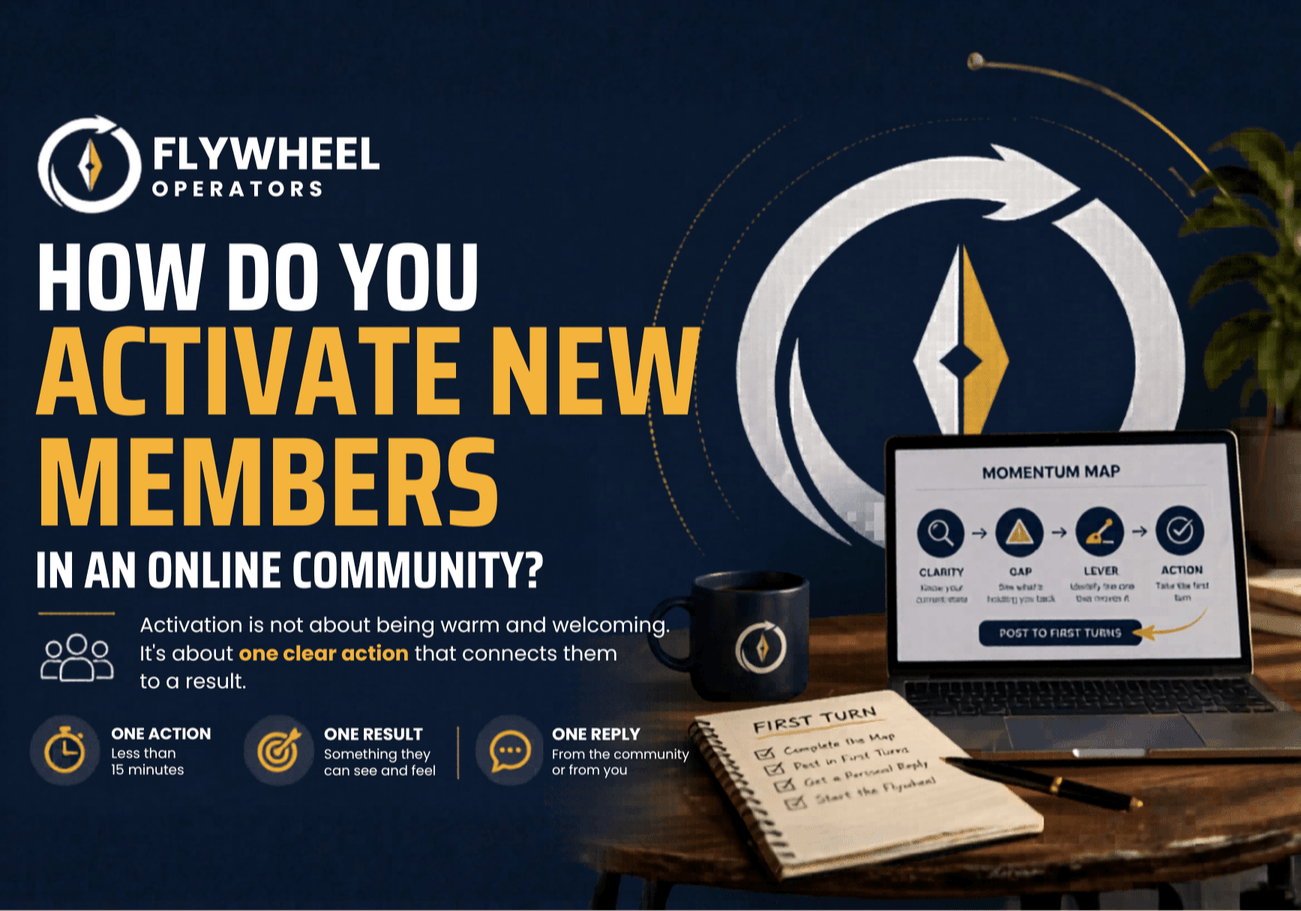
Activation means one new member completes one action that connects them to the reason they joined.
The action matters less than the fact that it happened. Because the moment someone does the thing, they become a participant instead of a spectator. And participants stay.
Why Most Activation Attempts Fail
The most common activation mistake is asking new members to do too much, too soon.
A 10-step onboarding checklist is not activation. It is a to-do list. And people who just joined your community did not come for more to-do lists.
The second most common mistake is making the first action about the owner's goals, not the member's result. "Introduce yourself" is fine. But it is not activation. It does not connect the member to the reason they paid.
Activation works when the first action:
- Takes less than 15 minutes.
- Produces something the member can see and feel.
- Opens a door to a response from the community or from you.
That is the structure. One action. One result. One reply.
The First Turn
Inside The Calm Engine, activation is built around one thing: the Momentum Map.
New members fill it in. It takes 10 minutes. It shows them exactly where their community flywheel is stalling and what one lever, when pulled, gets it turning again.
Then they post it in the First Turns category. And we respond personally with something specific to their community.
That exchange, map, post, personal response, is their First Turn. And the First Turn is where the flywheel starts.
Every Flywheel Operator in The Calm Engine started there. Not because we told them to. Because the structure made it the obvious next step.
What Happens When Activation Works
When a member completes their first action and gets a real response, something shifts. They stop being someone who joined and start being someone who belongs.
Engagement follows. Referrals follow. Long-term retention follows.
Activation is not the fun part. It is not the part people talk about when they describe their community vision. But it is the part that makes everything else work.
If your community goes quiet when you step away, the first place to look is activation. Because a member who was never properly activated is just waiting for a reason to leave.
If your community feels active only when you are present, go back to the core stall problem. Next, understand what happens after activation and why engagement drops.
Without this, members remain passive and engagement drops quickly.
Engagement
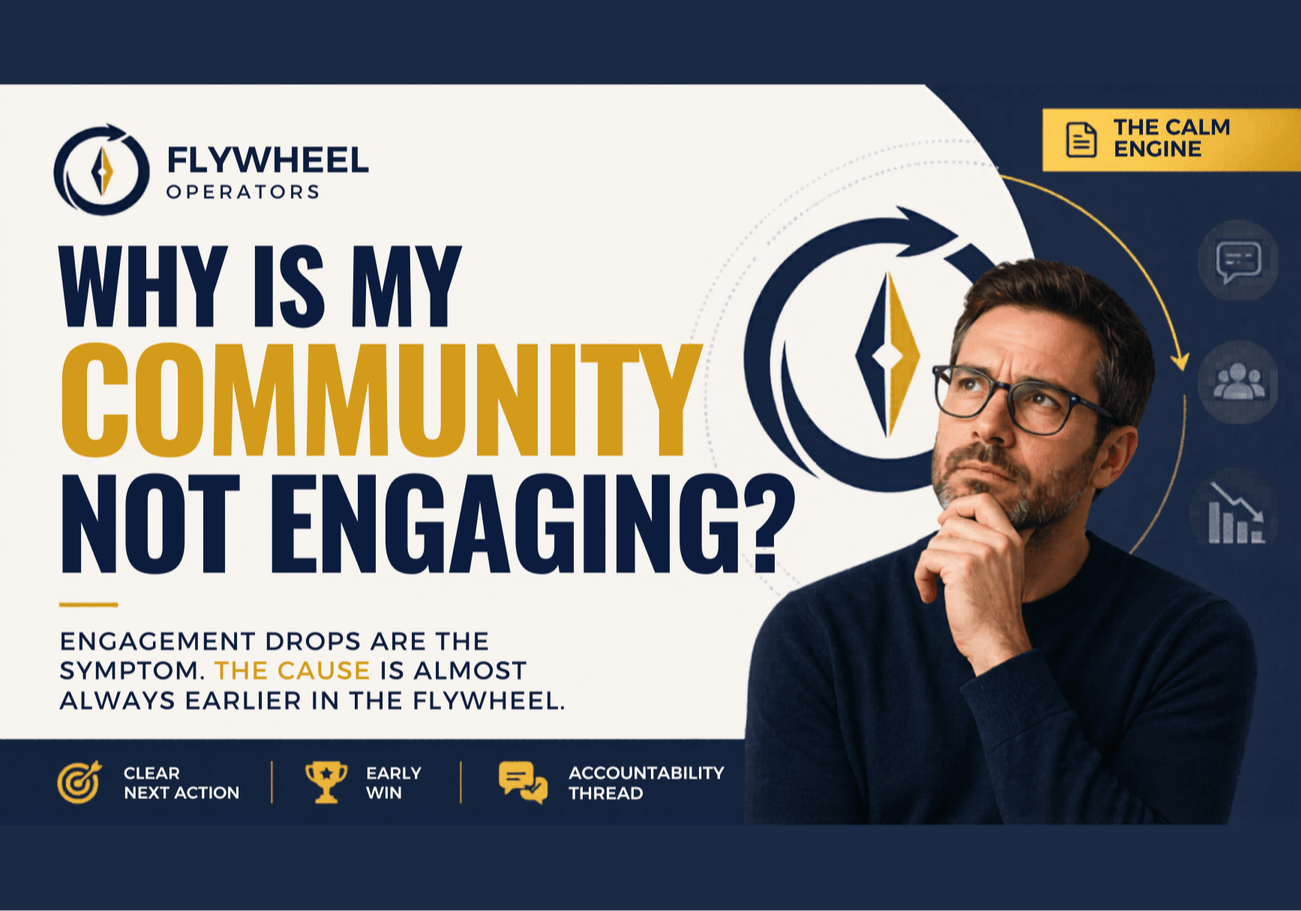
Engagement drops are the symptom everyone notices.
The cause is almost always something earlier in the flywheel.
You posted. You showed up. You asked good questions. And your community still went quiet. Here is what most community owners get wrong: they treat engagement as the goal. Engagement is the output. Structure is the input.
A quiet community is not a sign that your members do not care. It is a sign that they do not know what to do next. That is a direction problem, not a motivation problem.
What Engagement Actually Is
Why is my community not engaging?
It is one of the most common questions community owners type into search bars. And the answers they find are usually the same: post more consistently, ask better questions, engage first, try polls.
Those answers are not wrong. They are just treating the symptom.
Engagement is what happens when members have a reason to show up, know what to do when they get there, and feel that showing up was worth it.
All three conditions have to be met. Most communities only work on the first one.
They create reasons to show up: good content, good prompts, good energy. But they never build the structure that tells members what to do when they arrive, or the feedback loops that make showing up feel worthwhile.
So members come. They scroll. They like something. They leave.
That is not engagement. That is traffic.
The Three Engagement Killers
1. No clear next action.
When a member opens your community and there is no obvious thing to do, no thread to join, no question to answer, no action to take, they do the easiest thing. Nothing.
You cannot rely on good content to manufacture direction. Direction has to be built into the structure.
2. No early win.
Members who never experienced a win inside your community have no reason to believe another one is coming.
Engagement compounds from the first time something lands. If activation was skipped or shallow, there is nothing to compound from.
3. No accountability thread.
Engagement thrives in structure. The communities with the highest member-generated engagement almost always have one: a recurring, structured container where members are expected to show up.
- A weekly check-in.
- A progress thread.
- An accountability track.
When members know a container exists and they belong in it, showing up becomes a habit, not a decision.
What a Structural Engagement Fix Looks Like
The goal is not to increase your posting frequency.
The goal is to build three things:
- One recurring container that members can anchor to weekly.
- One clear first action that new members take within 48 hours.
- One feedback loop that makes participation feel seen and worth repeating.
Those three things, built once, generate more engagement per hour than daily manual posting ever will.
This is the difference between a community that runs on your presence and one that runs on structure.
If your community feels active only when you are present, return to why your community stalls when you stop showing up.
Why Engagement Drops When You Do
If your engagement numbers fall the week you take a break, that is not a coincidence. That is the design revealing itself.
A presence-dependent community needs the owner in the room. When you step back, the wheel stops because you are the engine.
A structure-dependent community does not have this problem. The containers run. The threads open. The accountability tracks keep members checking in.
And engagement happens because the structure created the conditions for it.
Not because you were online at 9 AM.
If your community goes quiet when you do, the engagement problem is actually a community flywheel problem and an activation problem.
Both of those have structure solutions.
Community Flywheel
Every successful community you admire has one thing in common.
It is not a charismatic founder. It is not a great niche. It is a flywheel. And most community owners have never heard the term in this context.
A flywheel is not a content strategy. It is not a posting schedule. It is the structure underneath everything that makes your community move forward on its own, whether you are in the room or not.
Most community owners are pushing a wheel. A flywheel pushes itself. The difference between the two is not effort. It is design.
Acquire
New members find you. They come from referrals, visibility, content, or direct outreach. The Acquire phase ends when they join.
What Is a Flywheel, Actually?
The flywheel concept comes from physics. A flywheel is a heavy rotating disk. The first few turns are hard because you have to apply real effort to get it moving. But once it has momentum, it keeps spinning with very little additional force. The energy stored in the spin is what keeps it going.
Applied to your community, a flywheel means this: you build the structure once, apply focused effort at the beginning to get it moving, and then the system sustains the momentum.
Members activating brings in new members. Engagement creates more engagement. Accountability keeps people showing up, which creates more activation, which keeps the wheel turning.
You do not have to keep pushing. The flywheel does the work.
Why Most Communities Do Not Have One
Most community owners were never taught to build a flywheel. They were taught to show up. Post consistently. Engage daily. Be present.
That advice builds something, but it is not a flywheel. It is a presence-dependent wheel, one that runs when you push it and stops when you do not.
The difference is structural. A presence-dependent community is built around the owner's activity. A flywheel community is built around member activity, structured into phases that feed each other.
The Four Phases of a Community Flywheel
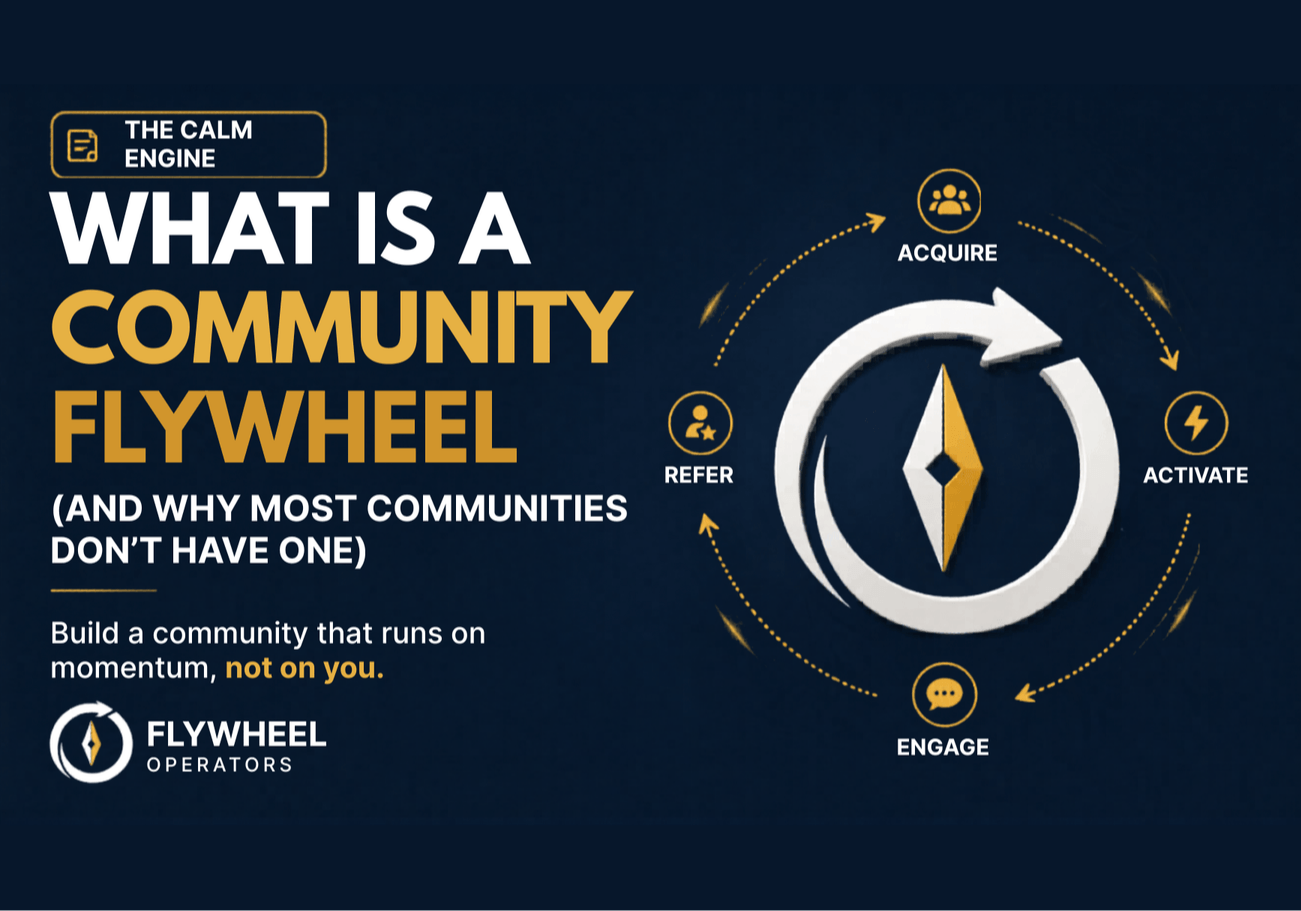
A community flywheel has four phases. They form a loop. Each one feeds the next.
Acquire.
New members find you. They come from referrals, visibility, content, or direct outreach. The Acquire phase ends when they join.
Activate.
New members take their first action. They complete something that connects them to the reason they joined. This is where most communities stall: members join and drift because activation was never built in. The Activate phase ends when the member has a First Turn.
If your members are joining but not doing anything, read How Do You Activate New Members in an Online Community?
Engage.
Members show up in structured containers. They check in on their progress. They interact with other members. Engagement is not random when the flywheel is working. It is created by recurring structure. The Engage phase runs continuously.
If your community feels quiet even when people join, read Why Is My Community Not Engaging?
Refer.
Members who got results become the community's best acquisition channel. They talk about it. They bring people in. The Refer phase loops back into Acquire and the flywheel picks up speed.
When all four phases are working, the community runs. When one stalls, the whole system slows.
Where Most Community Flywheels Stall
The most common stall points are Activate and Refer.
Activate stalls when new members have no clear first action. They join, browse, maybe introduce themselves, and then go quiet. Without a First Turn, they never fully become participants. And participants who never became participants eventually become former members.
Refer stalls when members have not had a result worth talking about. Referrals are not driven by goodwill. They are driven by outcomes. When members can point to something specific that changed because they were in your community, they refer. When they cannot, they might stay quiet, but they do not bring people in.
Knowing which phase your flywheel is stalling in changes everything. Instead of guessing and adding more content, you can go directly to the leak and fix the structure there.
That is what the Momentum Map is for. It is one exercise that shows you exactly where your flywheel is stalling in 10 minutes.
A flywheel is not complicated. It is just intentional.
You do not need a massive team, a complex tech stack, or years of community-building experience to build a flywheel. You need a clear Activate path, one recurring Engage container, and a simple way to recognize member results that creates Refer momentum.
Built right, that structure runs your community while you work on everything else.
That is what Why Your Community Stalls When You Stop Showing Up is about. It is the contrast between a community that runs on you and one that runs because you built it right.
Diagnosis: Momentum Map
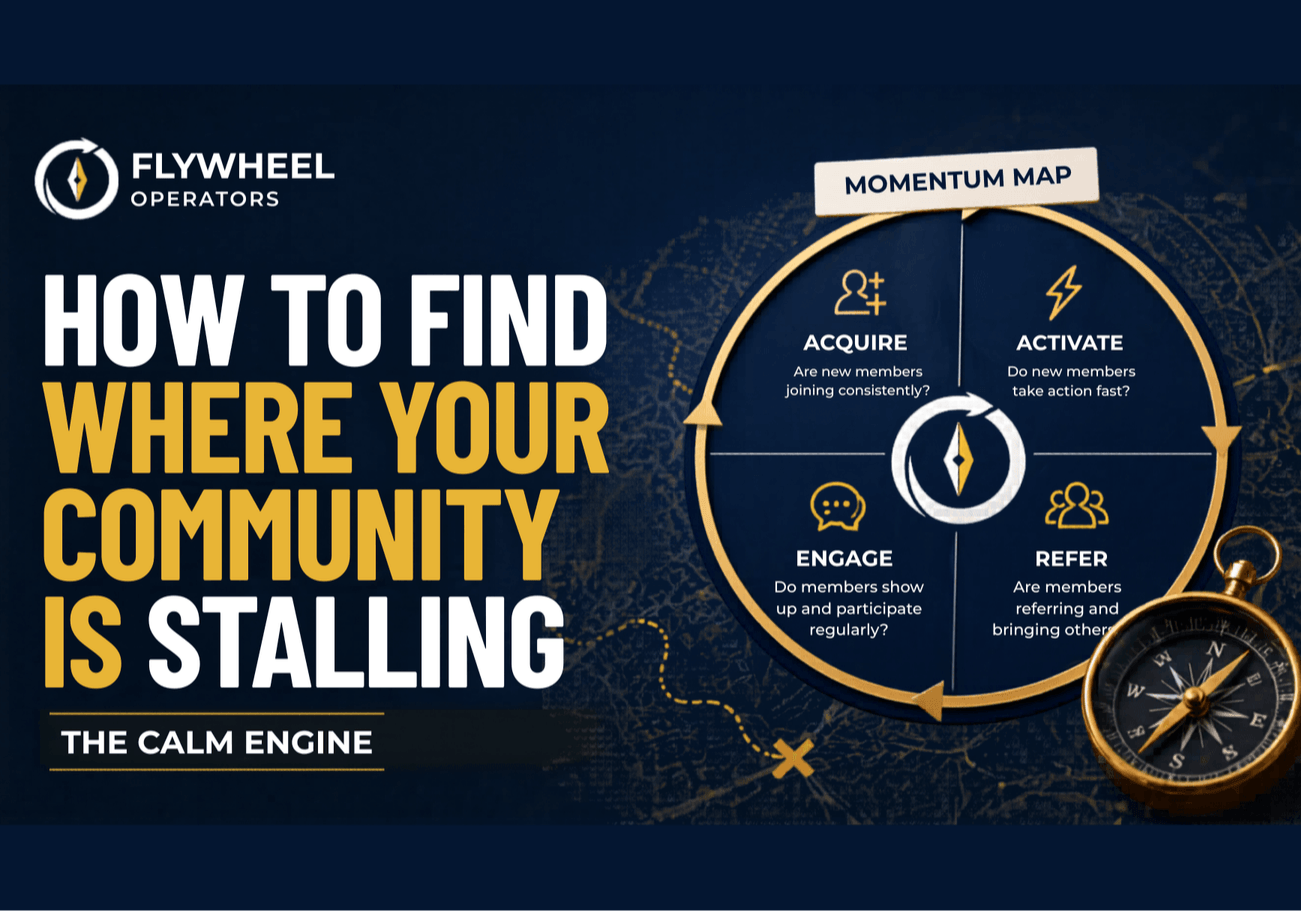
Interactive Momentum Map
Score each phase from 1 to 5. The lowest score points to the phase that needs attention first.
Want the fuller version? Take the 8-question diagnostic to identify the hidden bottleneck keeping your community from becoming self-sustaining.
Take the DiagnosticMost community owners know something is off.
They just do not know what to call it or where to look. The Momentum Map gives the stall a name.
You have been adding things to your community. More content. More prompts. More structure. And it still feels like pushing uphill. Here is why: you are adding to the wrong phase. The Momentum Map shows you which phase to actually fix.
Diagnosing a community problem without a framework is like troubleshooting an engine without a map. You replace parts that were never broken. The Momentum Map is the map.
Why Most Community Fixes Do Not Stick
When a community is not working the way the owner expected, the most common response is to add more.
More content. More engagement posts. More events. More onboarding steps.
Sometimes one of those additions lands. Usually they do not. Not because the ideas were bad, but because they were solving the wrong problem. The community has a specific stall, in a specific phase, and almost every fix that gets applied is aimed somewhere else.
The Momentum Map fixes this.
What the Momentum Map Is
The Momentum Map is a single diagnostic exercise. It takes about 10 minutes to complete.
It walks you through the four phases of a community flywheel: Acquire, Activate, Engage, Refer. It asks a small set of questions about what is happening in each phase right now. Not what you hope is happening. What is actually true today.
At the end of those questions, one phase stands out. That is your stall. The place where momentum is leaking. The phase where adding more elsewhere has no effect because the wheel is losing energy there first.
Knowing your stall changes everything about how you spend your time.
What Each Phase Looks Like When It Is Stalling
A community flywheel has four phases. They form a loop. Each one feeds the next.
Acquire is stalling when new members are not coming in consistently. The community is growing slowly or not at all. You are getting some signups from your own posts but almost nothing from member referrals. The fix is usually upstream in how you are creating visibility and what you are pointing people toward.
Activate is stalling when members join and go quiet. You get new members but the engagement does not increase in proportion. New members look around, introduce themselves if you are lucky, and then disappear. The fix is a clearer, lower-friction First Turn that connects them to a result fast.
If members are joining but not doing anything, fix this first: How Do You Activate New Members in an Online Community?
Engage is stalling when existing members are not showing up regularly. You have members who joined months ago and are rarely active. There is no recurring container pulling them back in. The fix is one structured weekly engagement anchor that gives members a reason to return.
If your community feels quiet even with members inside, read Why Is My Community Not Engaging?
Refer is stalling when your members are happy but not vocal about it. They stay. They participate. They are not bringing anyone in. The fix is almost always a result gap: members have not hit a specific, speakable win yet. Fix the result and the referrals follow.
- New members not joining means an Acquire problem.
- Members joining but going quiet means an Activate problem.
- Members not returning means an Engage problem.
- No referrals means a Refer problem.
Fixing the correct phase is what restores momentum.
How to Use the Momentum Map
The Momentum Map is not a worksheet you fill in and file. It is the beginning of a specific conversation about your community's structure.
When you complete it and post it in the First Turns category inside The Calm Engine, you get a personal response from Laura, specific to your community, your phase, and your stall. Not a generic answer. A structural diagnosis based on what your map actually shows.
That is the First Turn. And it is where the flywheel starts turning.
Most people who complete the Momentum Map say the same thing: "I knew something was off. I just did not know what to call it."
Now they do. And when you know where the stall is, you stop fixing the wrong phase. You go directly to the leak and close it. Structurally. Once.
For a full breakdown of why community owners end up in this position and what the structural alternative looks like, read Why Your Community Stalls When You Stop Showing Up.
For context on what a community flywheel actually is and why most communities do not have one, start with What Is a Community Flywheel?
The Momentum Map is free. It is inside The Calm Engine classroom.
Fill it in. Post it in First Turns. And get a personal response that tells you exactly which lever to pull to get your flywheel moving.
Solution: Build a Self-Sustaining Community
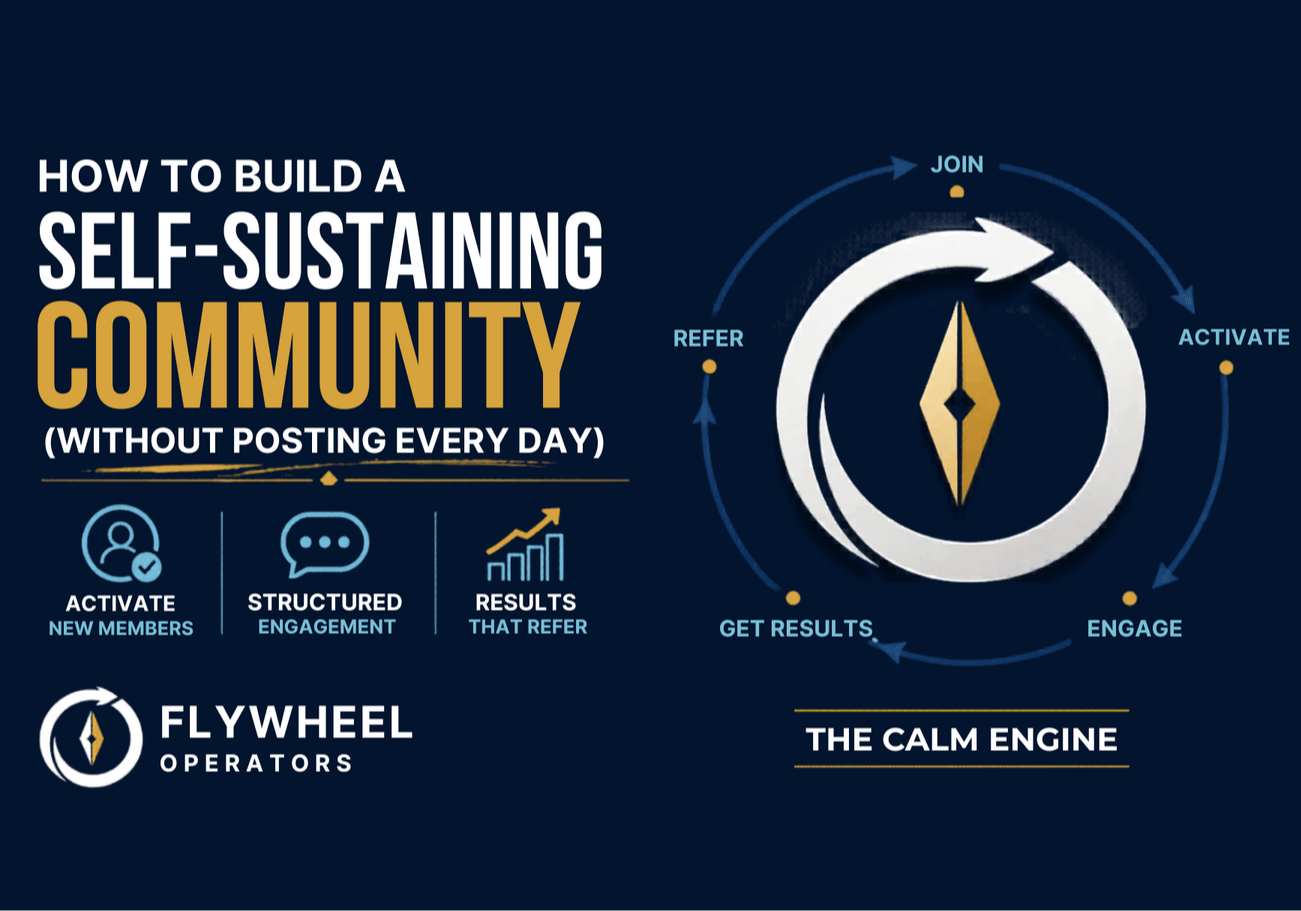
Most community owners think growth comes from doing more.
More posts. More replies. More time inside the community.
But if your community only works when you are working, you did not build a community.
You built a job.
A self-sustaining community does not require constant effort. It requires the right structure.
And that structure is a flywheel.
What a Self-Sustaining Community Actually Means
A self-sustaining community is one where:
- New members know exactly what to do when they join.
- Existing members return without being chased.
- Engagement happens inside structured containers.
- Members get results and talk about them.
This does not happen because the owner is active.
It happens because the system is working.
Most communities are missing that system.
Why Posting More Is Not the Solution
If your first instinct when engagement drops is to post more, you are solving the wrong problem.
Posting creates activity. It does not create momentum.
Momentum comes from structure.
This is why communities often feel busy one week and quiet the next. The activity is tied to the owner, not to a repeatable system.
If you step away and everything slows down, that is not a content problem.
That is a structure problem.
If this sounds familiar, start with Why Your Community Stalls When You Stop Showing Up.
The Three Components of a Self-Sustaining Community
1. Activation
Every new member takes one clear action within the first 48 hours.
Not a list. Not a welcome message. One action that connects them to a result.
If this is missing, nothing else compounds.
Read How Do You Activate New Members in an Online Community?
2. Structured engagement
Members do not engage because they feel like it.
They engage because there is a place to show up.
One recurring container:
- A weekly check-in.
- A progress thread.
- An accountability track.
This is where engagement becomes predictable.
Read Why Is My Community Not Engaging?
3. Results that lead to referrals
People do not refer communities because they like them.
They refer them because something worked.
When members can point to a specific result, referrals happen naturally.
Without results, growth stalls.
How the System Comes Together
When these three components are in place, the flywheel starts to turn.
- New members join.
- They activate.
- They engage.
- They get results.
- They refer others.
And the cycle repeats.
You are not pushing anymore.
You are maintaining a system.
If you want to understand how this system works as a whole, read What Is a Community Flywheel?
Where Most People Get Stuck
Most community owners are not missing effort.
They are missing clarity.
They do not know which part of their system is broken.
So they guess.
They add more content. More prompts. More complexity.
And the result does not change.
Because they are fixing the wrong phase.
This is why the Momentum Map exists.
If your community feels like it only works when you are there, you do not need to do more.
You need to fix the structure.
The Momentum Map shows you exactly where your flywheel is stalling and what to fix first.
It takes 10 minutes.
Inside The Calm Engine, you complete it, post it, and get a direct response on what to change.
That is where your flywheel starts.
Community Flywheel FAQ
Why do communities stall when the owner stops showing up?
Communities stall when the owner becomes the engine instead of building a system members can move through on their own. If posts, replies, activation, and engagement all depend on the owner being present, momentum stops when the owner steps away.
What is a community flywheel?
A community flywheel is a system where member actions create ongoing momentum through acquisition, activation, engagement, and referrals. Instead of relying on the owner to push every interaction, the structure helps members participate, get results, and bring others in.
How do you activate new members in a community?
You activate new members by giving them one clear, low-friction action within the first 48 hours. The action should connect them to the reason they joined, create a visible outcome, and trigger a response from the community or owner.
Why does community engagement drop?
Community engagement drops when members lack a clear next action, have not experienced an early win, or do not have a recurring structure that gives them a reason to return. Engagement is usually a structure problem, not a motivation problem.
What is the Momentum Map?
The Momentum Map is a diagnostic exercise that identifies where a community flywheel is stalling across Acquire, Activate, Engage, and Refer. It helps community owners stop guessing and fix the phase where momentum is leaking first.
How do you build a self-sustaining community?
You build a self-sustaining community by creating a clear activation step for new members, structured engagement containers for existing members, and member results that naturally lead to referrals. The community runs on structure instead of constant posting.